Before the Playlist: How Printed Song Collections Travelled
Printed song collections gathered tunes for singing and helped readers understand how format, notation, and song choices shaped shared music-making.
How did people choose songs for a gathering before a playlist could line them up? Printed song collections offered one answer: a book or pamphlet gathered tunes under a theme, carried them into a home, and gave several people a shared place to begin. A printed song collection was not simply a store of lyrics; it was a portable way to arrange music for use.
Song collection formats
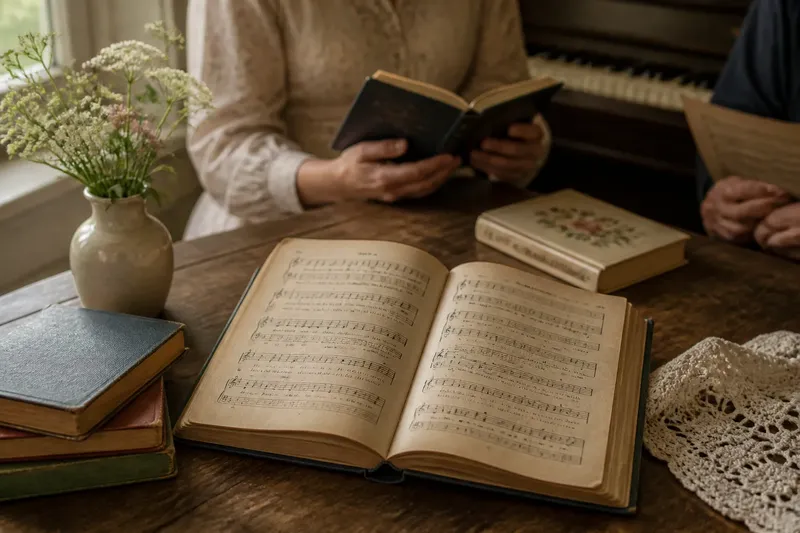
A song collection could be a bound volume, a small pamphlet, a sheet of popular songs, or a book assembled for a particular community or occasion. Some printed words alone; others included musical notation, melody lines, or accompaniment for keyboard or guitar. The contents and intended reader shaped what a collection could do.
A volume with notation invited a musically literate reader to sing or play from the page. A lyrics-only booklet could help people follow familiar tunes, even if someone had to supply the melody from memory. Collections might gather songs around a subject, a place, a social setting, or simply the publisher’s sense of what readers would want to sing.
That variety matters. “Songbook” does not mean one standard format or one kind of music-making. A collection might be used privately at a piano, passed around a room, or kept for reference rather than opened at every gathering.
Print and oral tradition
Printers and publishers selected songs they thought readers might buy or use. They could draw on familiar tunes, stage and popular entertainment, religious repertory, local traditions, or songs already circulating orally. Once printed, a tune’s words and musical details could be repeated in many copies, though editions might differ in spelling, notation, arrangement, or selection.
Print did not replace singing by ear. People could learn a song from family, neighbors, performers, or public gatherings, then encounter a printed version later. The page might help preserve a wording or melody, but it could also alter what had been remembered: a publisher could regularize a text, add accompaniment, or attach a song to a new theme.
Think of print as one path among several. A collection made a version easier to carry and revisit, while singers continued to adapt songs through performance.
How collections travelled
Where a printed collection circulated depended on its place, period, purpose, and local access to books. A publisher’s catalogue, a surviving inscription, or a library record may point to a particular route, such as a sale, gift, or loan. Without such evidence, it is safer to treat shops, schools, religious groups, libraries, and family visits as possible channels rather than assume every collection passed through them.
Format could affect how a book was used. A small pamphlet was easier to carry to a gathering than a large, heavily bound volume. A substantial book might instead be kept near a piano or on a shelf at home. Some collections were designed for practical participation; others could signal taste, education, or affiliation through their song choices and presentation.
Imagine a family in a particular town receiving a slim song booklet as a gift from a visiting relative. Someone recognizes a tune, finds its printed words, and brings the booklet to a neighbor’s evening gathering. The expected result is that more singers can follow the same wording, while the neighbor who knows the melody leads it. This imagined scene illustrates a possible use, not evidence about how any specific historical book travelled.
Shared singing
Collections could serve households, schools, clubs, religious groups, and other gatherings where singing had a place. They gave participants a common text and, when notation was included, a shared musical reference. That could make it easier for a group to start a song, keep track of verses, or agree on which tune belonged to particular words.
Access was not equal. Reading notation required skills that not every singer had, and the cost or availability of a book could shape who used it. A collection might also privilege the songs its compiler considered suitable, leaving other repertories outside the covers. In practice, people could bring songs from memory that never appeared on the printed page.
The book’s role was therefore social as well as musical. It helped coordinate participation, but it did not decide who sang, what a gathering valued, or how a tune should feel.
Changes between editions
Printing can make a song seem fixed, yet collections often reveal variation. A familiar lyric may appear with altered wording; a melody may be presented in a different key or with a new accompaniment; a title may differ from the one singers use. Editors made choices, and those choices became part of the version readers encountered.
Selections also shaped meaning. Placing songs together can suggest a theme or an intended audience, even when each song existed separately. A collection devoted to one kind of occasion frames its contents differently from a mixed volume of songs for home use. Readers could notice these patterns, but they could also ignore the sequence and turn straight to a favorite.
When comparing editions, look at the title page, contents, notation, and wording rather than assuming that a song has one definitive printed form. Those details can show how a publisher presented it.
Questions about song collections?
Were printed songbooks the same as playlists?
They share a basic function: both gather songs into an order or a usable set. A printed book, however, was a physical object whose contents were selected in advance, while singers could skip around, add tunes from memory, or use the pages without following the printed order.
Could people use a collection without reading music?
Yes, particularly when the words were printed for songs readers already knew. A lyrics-only collection could support participation, while notation and accompaniment were more useful to readers able to interpret them or to someone who could play.
Did a printed version preserve the original song?
It preserved a particular version, not necessarily an untouched original. Editors and publishers could revise words, notation, or arrangement, and oral singers continued to change songs as they passed them along.
Why were some songs collected together?
Compilers could organize songs by subject, audience, use, or commercial appeal. Their choices helped readers understand how a volume might be used, but the same songs could take on different meanings in another setting.
Reading a songbook today
Start with the book as an object and a proposal for singing. Notice its size and format, then check whether it contains words, notation, accompaniment, or a mix. Read the title page and contents to see whom the collection appears to address and how it groups its material.
- Check the title page for a named editor or intended audience; if one is given, use that clue to frame the collection, and if not, avoid assuming who it was for.
- Check for notation or accompaniment; if present, consider which readers could use it to lead singing, and if absent, allow for melody supplied from memory.
- Compare a song’s printed words with a version you know by ear; if they differ, treat the page as one version, and if they match, do not assume every singer used it.
- Check whether songs are grouped by subject or occasion; if a pattern appears, consider how it frames the volume, and if none appears, treat the selection as mixed rather than force a theme.
- Check the format and binding; if the item is compact, carrying it is plausible, and if it is large or heavily bound, consider a more stationary use without claiming that this proves its history.
- Check for inscriptions, ownership marks, or library records; if present, use them as evidence of a documented connection, and if absent, leave the book’s route uncertain.
These clues do not reveal every performance that took place, but they help distinguish what the book offered from what singers may have done with it. A printed song collection organized access, while people made the music live. That distinction is useful when tracing how songs moved before personal playlists: the page offered a version to revisit, but the evidence for where it went must come from the particular object and its context.