The More Instruments, the Richer the Song? Not Always
Learn how space and restraint keep song parts distinct, and choose when added instruments deepen a recording or simply crowd its best ideas.
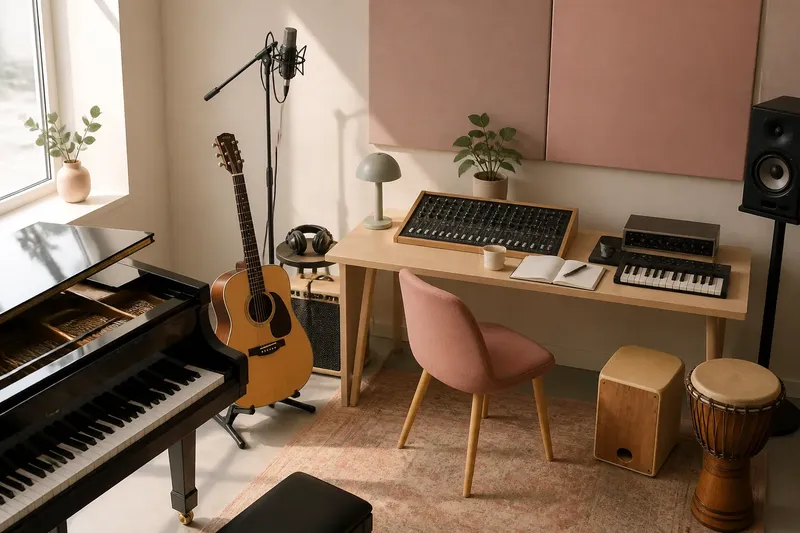
Does adding another instrument make a song richer, or just harder to hear? In recording, the answer depends less on the number of parts than on what each one contributes. A guitar, keyboard, backing vocal, or hand percussion can open a fresh color in a song. It can also occupy the same musical space as something already there, leaving the whole arrangement busier but less clear.
Think of a recording as a room shared by sound sources. Some parts take up the foreground; others sit at the edges or leave a gap. When each has a distinct job, a dense arrangement can still feel open. When several parts compete for the same attention, even a small ensemble can feel crowded. The useful question is not “What else can we add?” but “What would the listener notice if this part were here?”
Three arrangement choices
There is no single correct level of density. A song may benefit from a spare arrangement, a carefully layered one, or a fuller texture that grows across sections. These are different ways to direct attention, not rankings from simple to sophisticated.
Spare arrangements
A spare arrangement gives a small number of parts room to register. A voice and piano might carry a song with only a few supporting sounds, allowing small shifts in phrasing, harmony, and touch to come forward. A brief pause can feel meaningful because it is not surrounded by constant activity.
This approach suits songs whose interest lies in intimacy, a conversational vocal, or a clear melodic line. It can also help a lyric that needs space to be understood. But sparseness is not automatically expressive. If the parts repeat without changing their relationship, the recording may feel static; a held note, a changed register, or a carefully placed entrance can provide movement without adding a new instrument.
Selective layering
Selective layering adds parts only when they offer a different role, sound, or point of view. A muted guitar might supply a soft rhythmic pulse while a keyboard sustains chords. A backing vocal could answer the lead rather than shadowing every phrase. The result can feel fuller while preserving a clear path through the arrangement.
This approach suits songs that need extra motion or color but still depend on a prominent voice, groove, or melodic instrument. It is often useful when a section should feel broader than the one before it, yet the recording should remain easy to follow. Each added layer needs a reason the listener can hear, even if that reason is simply a brief contrast in tone.
Dense textures
A dense arrangement places several active parts together. That can create a lively, expansive, or deliberately crowded sound. A cluster of guitars, percussion, keys, and voices may convey a group moving as one rather than a single lead set against quiet support.
This approach suits music where collective energy is part of the character. It asks the listener to take in a blend rather than trace every detail. Density becomes a problem when the parts seem to demand attention in the same way: several bright sounds playing busy rhythms beneath a vocal, for example, can blur rather than intensify the song.
Choose an arrangement for the attention you want to guide, not the size of the track list.
Distinct musical roles
Before deciding whether a part belongs, describe its job in plain language. Is it carrying the pulse, outlining harmony, answering the vocal, adding a sustained backdrop, or introducing a contrast? If two parts have nearly the same job, that overlap may be purposeful, but it deserves a closer listen.
Role is not the same as instrument. A guitar can provide a clipped rhythm, a sustained chord, a countermelody, or a wash of sound. A keyboard can double the bass, add a high flourish, or hold a quiet note under the singer. Naming the role helps distinguish what the part does from what it is made of.
Imagine a recording with a steady piano chord pattern, a strummed acoustic guitar, and a lead vocal. If the guitar strums the same rhythm and chords as the piano, it may thicken the sound without adding a recognizable idea. The player could instead use shorter notes between the piano chords, or the guitar part could be left out. In the first option, the listener may hear a new rhythmic detail; in the second, the piano and vocal may become clearer. Which result suits the song is a musical choice, not a rule.
Space in the arrangement
Space is not empty by default. A pause before a vocal line can make the entrance feel more exposed. A gap between rhythmic accents can help a groove breathe. A part that stops while another continues can make the change in attention audible. These moments are arrangements too, even when they add no new sound.
Space also helps parts feel separate. If a bright guitar and a high keyboard both play quick figures at once, the listener may have trouble following either line. One could move to a lower register, play less often, or answer in the gaps. The point is not simply to make the mix quieter. It is to give musical ideas different places to stand.
Recording choices can reinforce those distinctions. A part that sits farther back in the mix may read as atmosphere, while a close, clear part may sound like a lead. Tone, timing, register, and level all shape the listener’s sense of distance. Adjusting one of these qualities may be more useful than adding another instrument to solve a problem of fullness.
When listening, try following one part at a time. If you can track the bass, vocal, and percussion separately, the arrangement is likely giving them room, even when the sound is full. If the parts disappear into a single blur, ask whether the intended effect is a unified mass or whether an overlap is hiding an important idea.
What should you listen for?
How can you tell if a song is overcrowded?
Listen for parts that mask a vocal, blur the pulse, or repeat another part’s figure without creating a noticeable change. Then ask whether that overlap gives the song a deliberate sense of weight or simply makes its main idea harder to follow.
Does a quiet part still count as a layer?
Yes. A soft sustained note, a faint backing vocal, or a lightly played percussion sound can shape the atmosphere and timing. Its contribution may be subtle, but it still occupies attention and sonic space.
Can the same part work in one section but not another?
Yes. A guitar figure may add momentum in a verse but compete with a vocal flourish elsewhere. Letting the part enter and leave can create contrast without changing the instrument or adding a new sound.
Should every instrument be audible on its own?
No. Some parts are meant to blend, support, or create a collective texture rather than stand out individually. The useful test is whether the blend supports the song’s character and leaves its central ideas legible.
Choosing a recording approach
Start by naming what the song needs the listener to notice first. If the vocal’s phrasing carries the emotional detail, choose an arrangement that leaves space around it. If a repeating rhythmic figure is the song’s engine, let other parts support its pulse without crowding its pattern. If the intended effect is a thick, communal rush, a dense texture may be the right fit.
Then compare options by listening for their consequences:
- Keep the arrangement spare when small changes in delivery, touch, or silence should stay prominent.
- Add a contrasting layer when the song needs motion, response, or a new color that existing parts do not provide.
- Build a dense texture when collective energy or a deliberately blended sound matters more than hearing every part separately.
- Change the part’s role when its sound is useful but its current rhythm or register competes with another line.
- Let a part enter selectively when it helps one section but distracts in another.
These choices can coexist within one song. A spare opening might make a later entrance feel larger; a dense section might clear space again for a quiet phrase. The contrast works because the arrangement changes what the listener attends to, not because each new section must contain more instruments.
Let the song breathe
The more-instruments question is best answered by listening for distinct jobs and clear relationships. A part earns its place when it changes the feeling, motion, color, or shape of the recording in a way that serves the song. Sometimes that means adding a sound. Sometimes it means asking an instrument to play differently, appear only briefly, or stay silent.
On your next listen, follow the part that seems least noticeable. If removing it in your imagination would change the song’s character, it may be doing quiet but useful work. If nothing seems to change except that the sound becomes easier to follow, restraint may be the richer choice.